Short answer: AI agent trading is exploding in 2026 — Claude, ChatGPT, Cursor and Gemini can all now read a portfolio and place an order through the Model Context Protocol (MCP). But there’s a critical distinction most people miss: an AI deciding what to trade and an AI executing what you tell it to trade are two completely different — and differently risky — things. AlgoVesta’s MCP server never lets AI pick trades. Your signal, your rules, your risk limits decide; the AI just acts on them, in seconds, across 16 crypto exchanges and MetaTrader 5.
“AI agent trading” is one of the fastest-growing terms in finance right now. Every week brings a new headline about a language model reading a portfolio, reasoning about a position, and placing a live order. It’s genuinely a new category — and it raises a genuinely important question: is the AI deciding the trade, or executing it? That one word changes everything about how safe the system is.
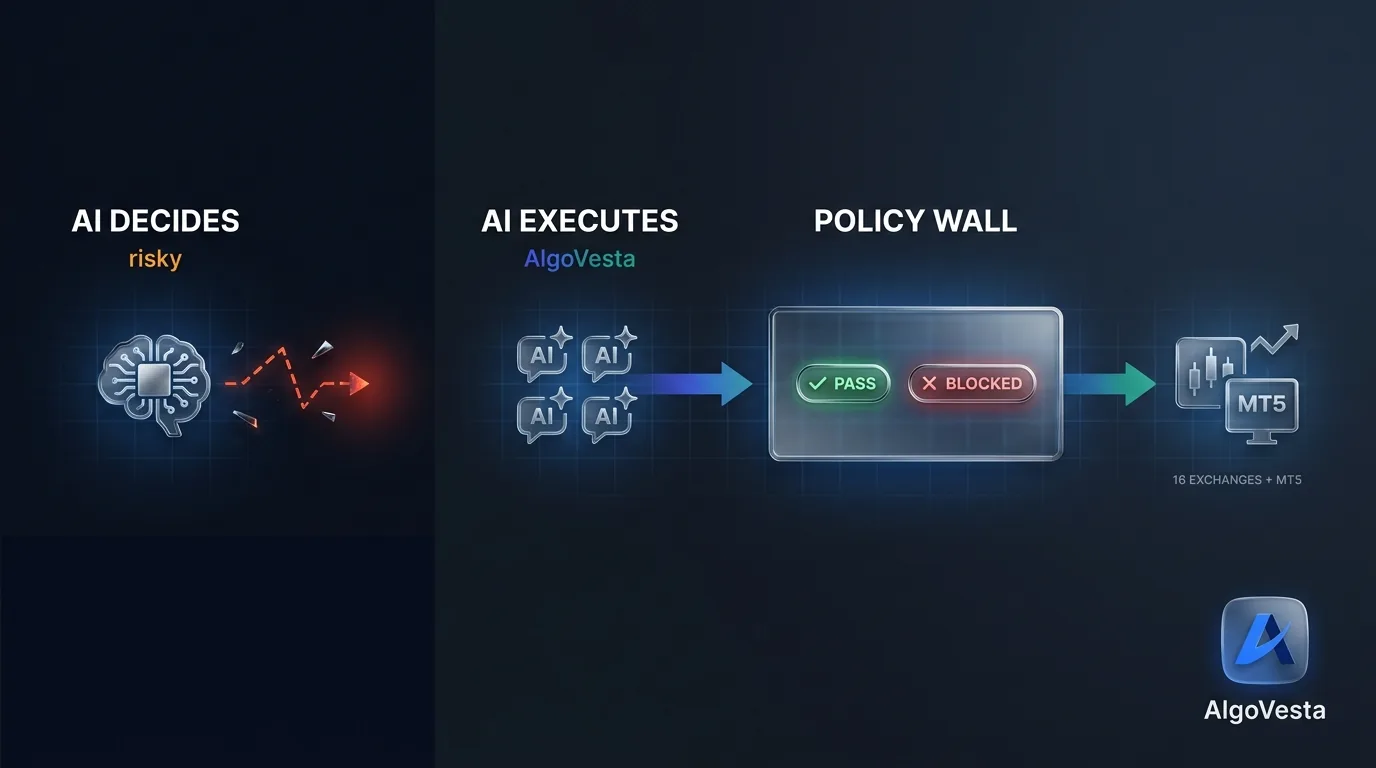
The AI-picks-the-trade problem
Ask any large language model — Claude, ChatGPT, Gemini, doesn’t matter which — to predict where an asset is going, and you get a confident, well-written answer. The problem is confidence isn’t accuracy. Independent trading benchmarks in 2026 have repeatedly shown the same pattern: language models asked to decide trades produce inconsistent, often losing results, stated with exactly the same fluent tone whether they’re right or wrong. A model can build you a technically flawless trading bot and still lose money live, because writing code and making correct market calls are not the same skill.
This is the part the “AI picks winning trades” hype skips over. An AI reasoning about markets is genuinely useful — for research, for summarizing news, for explaining a chart. It is not the same thing as an AI that should be given the authority to decide your position size and pull the trigger.
The execution-only alternative
AlgoVesta is built on a different principle entirely: the AI never decides what to trade. It doesn’t generate signals, doesn’t forecast price, and doesn’t get final say on any order. What it does is execute — instantly, exactly, and only within the rules you set in advance.
The signal that drives a trade comes from a source you choose: your TradingView strategy, a Telegram channel you trust, or your own reasoning typed straight into an AI assistant. From there, AlgoVesta’s job is narrow and mechanical: parse the signal, check it against your risk rules, and place the order — or don’t, if it fails the check. There is no step where an AI model is asked “should this trade happen?” That question was already answered by you, before the signal ever arrived.
MCP: talk to Claude, ChatGPT, Cursor or Gemini — the rules still decide
This is where it gets interesting for anyone using an AI assistant day to day. Through the Model Context Protocol (MCP), AlgoVesta connects directly to Claude, ChatGPT, Cursor, Gemini, or any other MCP-capable client. You can talk to your assistant in plain language — “show me my portfolio,” “simulate a small long on this pair,” “close everything on MetaTrader” — and it can act, across 16 crypto exchanges and MT5, from one connection.
But here’s the architectural detail that matters: when your AI assistant asks AlgoVesta to place an order, that request still passes through a server-side policy wall — the same risk rules every other signal source obeys. The AI can propose an action in conversation, but it cannot override your stop-loss, your position size limit, or your daily loss cap. No clever prompt, no “ignore previous instructions” trick, no persuasive reasoning changes what the policy wall allows. The assistant gets a simple PASS or BLOCKED — it never gets to argue.
So whether the request comes from Claude, ChatGPT, Cursor, or a TradingView webhook, the answer to “should this trade go through” is decided by rules you configured, not by a model’s judgment in the moment. Curious about the mechanics behind this? See our breakdown of how AlgoVesta's MCP trading server actually works, or what it looks like to trade by talking to your AI.
Why this distinction is the whole safety model
Every part of AlgoVesta’s architecture follows from this one principle — AI acts, rules decide:
- Paper-first by default. Every new connection, including every new MCP link, starts on a $5,000 virtual balance. You can let an AI assistant “trade” freely here with zero real risk, because nothing it does touches actual funds.
- Mandatory stop-loss, hard leverage cap. No order — AI-initiated or otherwise — opens without a stop-loss, and leverage is capped server-side. The AI cannot loosen either, even if asked to.
- Trade-only access, always. Withdrawal permission is never granted to any connection — AI assistant included — so funds physically cannot be moved out.
- A signed, tamper-evident receipt for every action. Whatever triggered an order — Telegram, TradingView, or an AI agent — there’s a verifiable, unforgeable record of exactly what happened and why.
- A one-tap kill switch. Freeze every channel, including AI agent access, instantly.
None of this exists to slow you down. It exists because “AI agent trading” is powerful precisely when the agent is fast and helpful with execution, and dangerous the moment it’s trusted with judgment it hasn’t earned.
The bottom line
2026 is the year AI agents stopped just talking about trades and started placing them — Claude, ChatGPT, Cursor and Gemini can all act through MCP now. That’s real progress. But the traders who benefit from it are the ones who keep the AI on execution duty and keep the decisions — the strategy, the risk limits, the stop-loss — in their own hands. AlgoVesta was built exactly that way: talk to your AI assistant, bring your own signal, and let the rules — yours, not the model’s — decide what actually happens.
Connect your AI assistant to AlgoVesta →
Learn more: the live demo.
Related comparisons: Mudrex · 3Commas · Cryptohopper
Disclaimer. AlgoVesta is signal-routing and execution infrastructure. It does not generate signals, does not hold, receive, or move client funds, and does not provide investment advice or trading recommendations. AI assistants act only within the rules and risk limits you configure, and you are responsible for both. Crypto and forex trading carry substantial risk of loss; leveraged positions may be fully liquidated. Past performance does not guarantee future results.
The authoritative version of this article is the English original; translations are provided for convenience.
Ready to automate your trading workflow?
Connect your exchange with secure, trade-only API keys.
Start Free — 7 Days