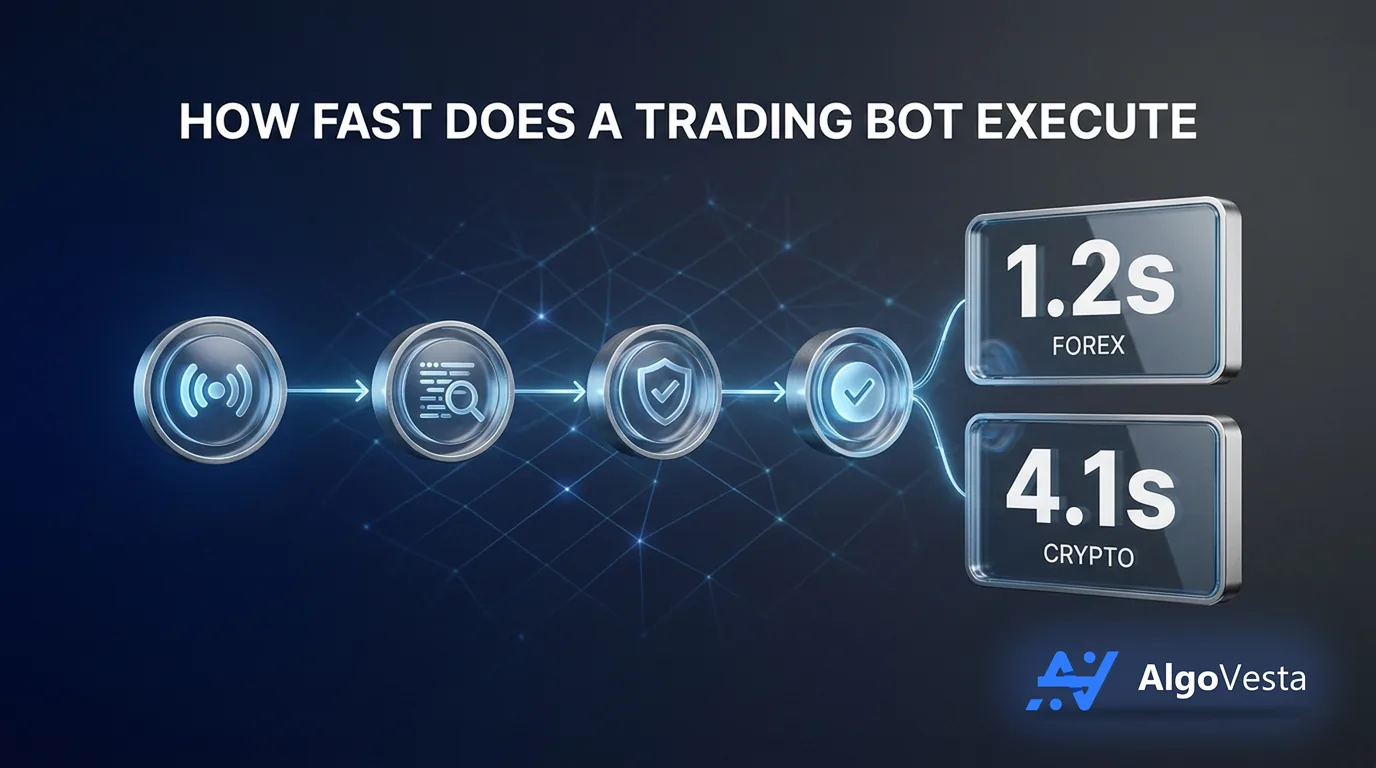
Short answer: Execution speed is the gap between a signal firing and an order actually landing on the exchange or broker — and it’s the single number that decides whether automation captures the price a signal intended, or arrives after it’s gone. Across 10,000 live-tested trades, AlgoVesta averages 1.2 seconds on MetaTrader 5 forex and 4.1 seconds on crypto exchanges, including stop-loss and take-profit attachment. This guide breaks down what actually causes delay in automated trading, why forex and crypto speeds differ, and what to check before trusting any platform’s speed claims.
To run this on your own exchange account, start with crypto signal automation.
Every trading automation platform claims to be “fast.” Almost none show you a number. Speed sounds like a marketing detail until you’ve watched a signal fire and an entry move before the order landed — at that point it’s the only detail that matters. This is what execution speed actually measures, why it varies by market, and how to tell a real number from a marketing one.
What “execution speed” actually measures
Execution speed is the full path from signal to filled order, not just the network round-trip to an exchange. It includes every step that has to happen in sequence:
- Receiving the signal — a Telegram message, a TradingView webhook, or an AI assistant’s request via MCP.
- Parsing it — extracting symbol, direction, size, stop-loss and take-profit from whatever format it arrived in.
- Checking it against risk rules — position sizing, daily limits, and any optional signal filter.
- Placing the order — and, critically, attaching stop-loss and take-profit as part of the same fill, not as a separate step afterward.
A platform that only measures step 4 and calls it “execution speed” is quoting a number that ignores most of the actual delay. The number that matters is signal-to-fill, SL/TP included.
Why forex (MT5) and crypto execution speeds differ
On AlgoVesta, the measured averages across 10,000 live-tested trades are 1.2 seconds for MetaTrader 5 forex and 4.1 seconds for crypto exchanges — and the gap isn’t a flaw, it reflects a real architectural difference:
- MetaTrader 5 runs through a persistent terminal connection that AlgoVesta hosts and keeps continuously connected to the broker — there’s no cold connection to establish per trade, which is part of why forex fills land faster.
- Crypto exchanges are reached over REST APIs per venue, and each of the 16 supported exchanges has its own API behavior, rate limits, and order-matching latency — a small but real amount of that time is outside any platform’s control, decided by the exchange itself.
Any platform claiming identical speed across every crypto exchange and MT5 is glossing over this — the underlying infrastructure genuinely isn’t the same.
What actually causes slow execution
When automation feels slow, it’s almost always one of these:
- Polling instead of push-based delivery — some setups check for new signals on an interval rather than reacting instantly, adding dead time before processing even starts.
- A separately hosted VPS or bridge — for MetaTrader specifically, a self-managed VPS or Expert Advisor adds its own network hop and reliability risk on top of whatever the platform itself takes. (More on why this hop exists at all: the no-VPS explainer.)
- No SL/TP in the same fill — placing an entry, then a separate stop-loss order afterward, doubles the exposure window before protection is actually in place.
- Sequential risk checks with no optimization — a poorly built risk layer can add real, avoidable latency if it isn’t designed for speed.
AlgoVesta’s MetaTrader integration removes the VPS/bridge hop entirely by hosting the terminal connection directly, and both TradingView and Telegram signals attach SL/TP as part of the same order placement — not a follow-up step.
How to check a speed claim before you trust it
Most platforms describe themselves as “instant” or “lightning-fast” with no measurement behind it. Before trusting a claim, look for:
- A specific number, not an adjective. “Fast” means nothing; “1.2 seconds average across 10,000 trades” is a claim you can question and verify.
- Separate numbers per market. A single blended average across crypto and forex usually hides the slower of the two.
- Whether SL/TP is included. A fast entry with unprotected exposure afterward isn’t the same as a fully protected fill.
- A live demo you can time yourself. The most honest proof of a speed claim is pasting a real signal and watching it execute — no signup required, so you’re not taking anyone’s word for it.
Why speed matters more on some signals than others
Execution speed isn’t equally important everywhere. A slow-moving, wide-stop swing signal barely notices a few seconds of delay. A tight-stop scalping signal, or a fast-moving crypto perpetual during a volatility spike, can have its entire edge erased by the gap between signal and fill. If your strategy or the channels you follow trade tight setups, execution speed stops being a nice-to-have and becomes the difference between the backtest and the live result.
Related reading
The bottom line
“Fast” is a claim; a measured number across thousands of real trades is evidence. AlgoVesta’s 1.2-second forex and 4.1-second crypto averages — SL/TP included, across 10,000 live-tested trades — reflect the actual signal-to-fill path, not a cherry-picked best case. If speed matters to your strategy, don’t take any platform’s word for it: test it yourself, live, in seconds.
Related comparisons: PineConnector · Cornix · 3Commas
Disclaimer. AlgoVesta is signal-routing automation infrastructure (Bring Your Own Signal). It runs execution infrastructure on your behalf using trade-only credentials; it does not generate signals, hold, receive, or move client funds, and does not provide investment advice or trading recommendations. Execution times are averages measured across live-tested trades and may vary by exchange, network conditions, and market volatility. Crypto and forex trading carry substantial risk of loss; leveraged positions may be fully liquidated. Past performance does not guarantee future results.
The authoritative version of this article is the English original; translations are provided for convenience.
Ready to automate your trading workflow?
Connect your exchange with secure, trade-only API keys.
Start Free — 7 Days