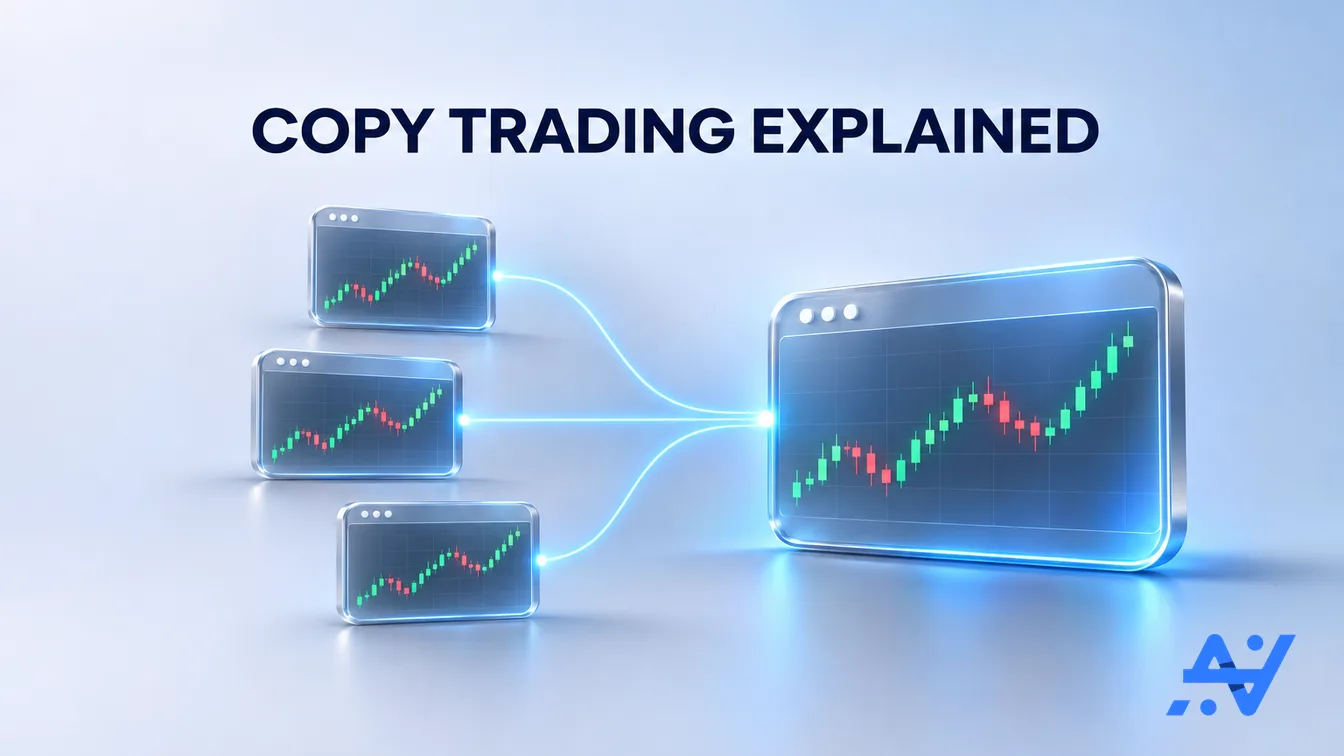
Short answer: Copy trading means your trading account automatically repeats the trades of another trader, scaled to the size of your balance. When the person you follow opens a position, your account opens the same one; when they close it, yours closes too. It is simple to start, but you also copy their leverage, their exits and their losses, so the real question is what limits you keep for yourself.
If you already know which signals you want to follow, a Telegram signal copier lets you run them under your own rules.
This guide explains what copy trading is and how it works, without the marketing. If you are already comparing platforms, our article with copy trading tips and safer alternatives goes further; for a one-paragraph version, see the short glossary definition.
How copy trading works, step by step
Every copy trading setup has the same three parts: a leader (the trader whose account is copied), a follower (you) and a platform or connection that passes the trades between them.
- You choose a leader. Usually from a ranking on a broker or exchange, or by linking to a specific master account.
- You set an allocation. You decide how much of your balance follows that leader. Trades are scaled to it: if the leader uses 10% of their account on a trade, a proportional amount of your allocation is used.
- The leader trades, your account follows. Each open, partial close and full close is repeated on your account, usually within seconds.
- Fees are taken. Depending on the platform, the leader or the platform takes a share of profits, a subscription or a markup on the spread.
- You stop when you choose. You can stop copying at any time; what happens to positions that are still open depends on the platform.
The important detail is step 3: the leader decides the symbol, the direction, the leverage and the exit. In most setups you can only change how much money follows them.
Copy trader, copy trade, social trading: the words people mix up
Search results use these words loosely, which makes the topic more confusing than it is:
- Copy trader can mean the person who copies, the person being copied, or the software that does the copying. When a platform says "become a copy trader", it usually means following someone.
- A copy trade is a single trade that was opened on your account because the leader opened it.
- Social trading is the wider idea of seeing and discussing other traders' positions. Copy trading is the automated part of it.
- Mirror trading is an older term for copying a strategy rather than a person; in practice it works the same way.
Types of copy trading
Marketplace copy trading
A broker or exchange lists traders with their past results, and you pick one to follow. Everything happens inside that one platform, so you can only copy traders who trade there.
Account-to-account copying
A master account is linked to one or more follower accounts, often on MetaTrader. This is common between accounts of the same person or within a small group, and is also called trade copying or channel mirroring when the source is a feed.
Signal copying
Here nobody's account is copied. A signal, a message such as "Buy gold, stop-loss 2640, take-profit 2665", is read from a source you chose, for example a Telegram channel or a TradingView alert, and turned into an order on your account. This is what a signal copier does, and the difference matters more than it looks: the size and the limits come from you, not from someone else's account. Signals are usually shared in Discord or Telegram signal channels.
What copy trading costs
The price of copy trading is rarely one number. Before you start, look for each of these:
- Profit share. A percentage of the profit made on your account, taken by the leader or the platform.
- Subscription. A fixed monthly fee to follow a leader or to use the copying tool.
- Spread and commission. The normal trading costs of the broker or exchange still apply to every copied trade.
- Slippage. Your order fills after the leader's, so the price you get can be slightly different, especially on fast markets.
A leader with frequent small trades can look good on paper and still lose money for followers once spread, commission and slippage are counted on every trade.
The real risks of copy trading
Copy trading does not remove risk; it hands most decisions to someone else. These are the risks that matter in practice:
- You inherit their risk management. If the leader uses high leverage or no stop-loss, so does your account.
- Past results are selected. Rankings show traders who did well recently. Traders who blew up are often no longer listed, so the list looks better than reality.
- Style changes without notice. A careful trader can start taking bigger risks after a losing streak, and you only see it in your balance.
- Different fills, different results. Your entries come after the leader's, so even a perfect copy does not give the same result.
- Your account size changes the outcome. On a small balance, the broker's minimum lot can make a copied trade much larger, relative to your account, than the leader's.
The protection is to keep limits that do not depend on the leader: a daily loss limit, a maximum number of open positions, a kill switch that stops everything, and a size you have checked with a position size calculator. If a tool promises returns or hides how it trades, compare it with these red flags to watch for in trading bots.
Copy trading vs. signal copying
Both automate trades you did not place yourself. The difference is who controls the trade once the idea arrives:
| Copy trading | Signal copying | |
|---|---|---|
| Source | Another trader's account | A signal source you choose (Telegram, TradingView, an AI assistant) |
| Position size | Scaled from the leader's trade | Set by you (fixed or risk-based) |
| Stop-loss and leverage | The leader's | From the signal, within your own limits |
| Where you can trade | Usually one platform | The exchange or broker account you connect |
| What stops a bad day | Unfollowing | Your daily loss, drawdown and position limits |
Neither is safe by default. Copy trading suits people who want to hand over decisions completely; signal copying suits people who trust a source but want to keep the controls.
How to check a trader or a channel before you copy
Whether you follow a leader or a signal channel, the checks are similar:
- Look for a long history, not a good month. Ask how the worst period looked, not the best.
- Check what the stop-losses look like. No stop-loss, or stops moved every time, is a warning.
- Prefer sources that publish exact entries, stop-losses and targets before the move, not results after it.
- Start on demo or with a small amount, and compare the first trades with what the source published.
For signal channels specifically, here is how to evaluate a signal channel before following it, and a 30-day reality check of real signal channels shows how many channel messages are actual signals.
Is copy trading legal, and is it for beginners?
Copy trading is offered by regulated brokers in many countries, but the rules depend on where you live and on the platform. Check that the platform is allowed to serve your country and read what it is responsible for. Nothing in this article is investment advice.
For beginners, copy trading is easy to start and easy to misunderstand. The main mistake is to treat it as passive: you still own every loss. If you try it, start with money you can afford to lose and keep your own limits on top.
Where AlgoVesta fits
AlgoVesta is not a copy trading marketplace and does not offer traders to follow. It is signal-copying software: you choose the source, such as a Telegram channel, a TradingView strategy or an AI assistant connected over MCP, and AlgoVesta executes those signals under your rules on your own account. It works with 16 crypto exchanges and with MT5 forex accounts, without a VPS or an EA on your computer.
Your rules sit in front of every trade: position size, maximum open positions, daily loss and drawdown limits, and a panic button that closes what AlgoVesta opened. Exchange accounts are connected with a trade-only API key without withdrawal rights. You can test with paper trading or a demo account first, and the 7-day free trial needs no credit card.
Frequently asked questions
The bottom line
Copy trading lets another trader's decisions run on your account. That is its appeal and its main risk. Before you follow anyone, check how they handle losses, count every cost, start small and keep limits that work even if the leader gets it wrong. If you want automation but prefer to keep those decisions, signal copying with your own rules is the other route.
Disclaimer. AlgoVesta is signal-routing automation infrastructure (Bring Your Own Signal). It runs execution infrastructure on your behalf using trade-only credentials; it does not generate signals, hold, receive, or move client funds, and does not provide investment advice or trading recommendations. Execution times are averages measured across live-tested trades and may vary. Crypto and forex trading carry substantial risk of loss; leveraged positions may be fully liquidated. Past performance does not guarantee future results.
The authoritative version of this article is the English original; translations are provided for convenience.
Ready to automate your trading workflow?
Connect your exchange with secure, trade-only API keys.
Start Free — 7 Days