Research at AlgoVesta: how we measure our operating data
We publish aggregate measurements from AlgoVesta's own production systems: what happens to signals, how orders are placed, whether positions carry protective orders and which markets customers trade. Every figure states its window, its sample size and the day it was measured. We do not publish profit, loss or win rates, and nothing on this page is investment advice.
Latest study (measured 11 November 2026): of 1,831 MetaTrader 5 positions AlgoVesta opened on live broker servers between 13 August and 10 November 2026, 94.0% were gold.
What do we measure?
We measure how the service behaves, not how customers perform. The tables cover:
- what happens to each incoming signal from Telegram and TradingView: executed, filtered by a customer rule, or rejected, and why;
- how orders reach MetaTrader 5 and crypto exchange accounts, and whether the stop-loss and take-profit exist on the account;
- why positions were closed, and how MT5 account connections succeed or fail;
- which instruments and opening hours appear in the positions AlgoVesta opened.
Where does the data come from?
From AlgoVesta's production database, queried in a read-only session that is rolled back at the end, so nothing is written during a measurement. The sources are the Telegram decision audit, the TradingView webhook log, crypto and MT5 trade records, MT5 login attempts and paper-trading records. Each query is versioned, and its fingerprint is kept with the result.
What is excluded?
Our own hourly monitoring account, residue from test runs, and deleted accounts are removed from every query. Live and demo trading are reported separately and never added together; an MT5 server whose name contains "demo" is treated as demo.
How is customer privacy protected?
We publish aggregates only. A group with fewer than five customers is hidden, even when it would make a table more interesting. No figure on this page identifies a customer, and we publish no balances, no account sizes and no individual results.
Latest study: copied MT5 positions, August to November 2026
Window: 13 August to 10 November 2026 (90 days). Measured: 11 November 2026. Scope: MetaTrader 5 positions AlgoVesta opened on live broker servers for 25 customers, from signal sources the customers chose: 1,621 positions from Telegram channels and 210 from TradingView alerts.
| Measurement | Result | Sample |
|---|---|---|
| Share of positions in gold | 94.0% | 1,831 positions, 25 customers |
| Median distance from entry to the last recorded stop-loss (gold) | 0.20% of entry price (middle half 0.10% to 0.26%) | 1,721 positions, 24 customers |
| Gold positions with the last recorded stop within 0.02% of entry | 18.7% (322 positions) | 1,721 positions, 24 customers |
| Positions opened between 00:00 and 07:00 UTC | 29.9% | 1,831 positions, 25 customers |
| Positions opened between 12:00 and 16:00 UTC | 19.7% | 1,831 positions, 25 customers |
| Busiest opening hour | 10:00 UTC | 1,831 positions, 25 customers |
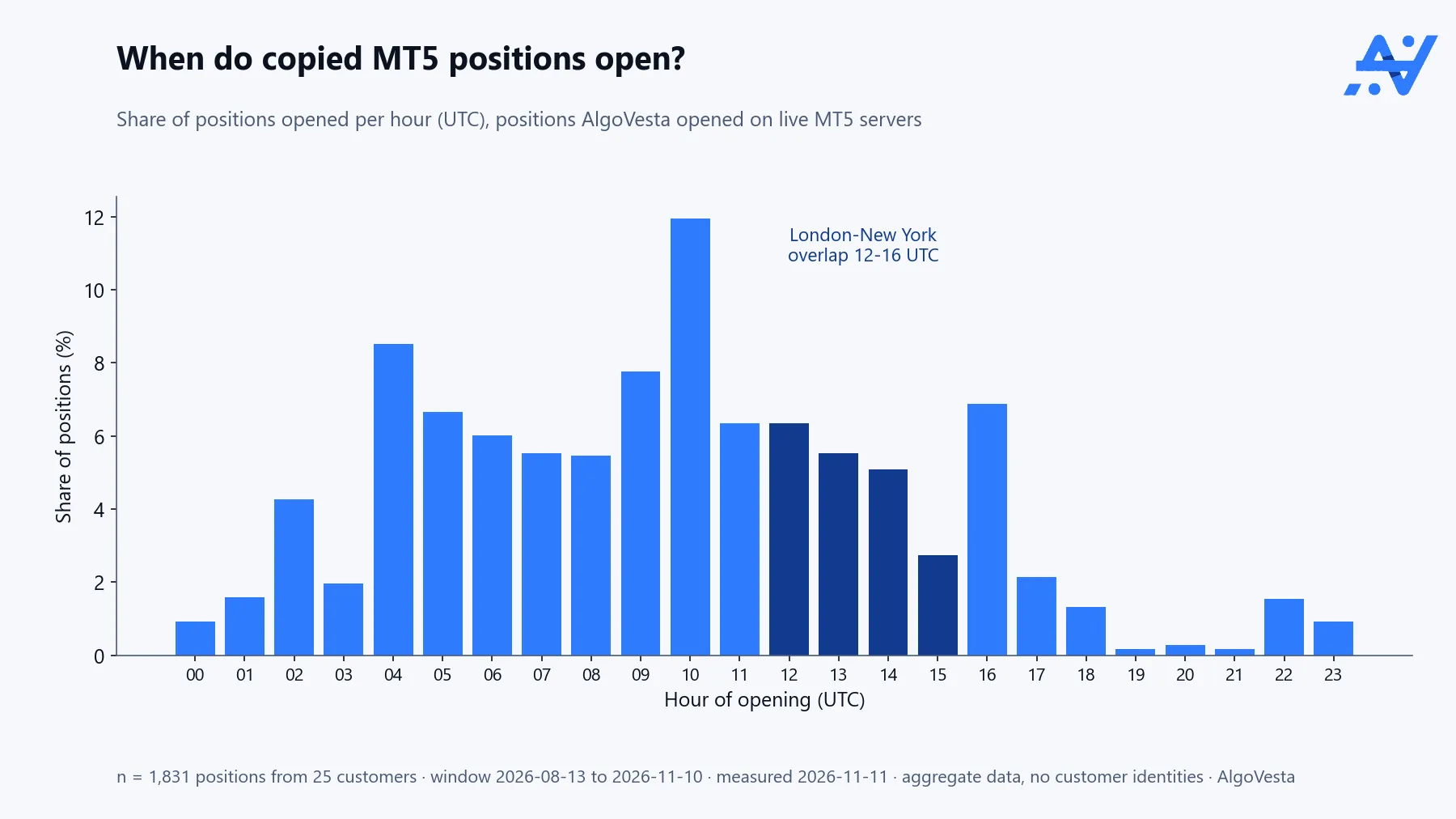
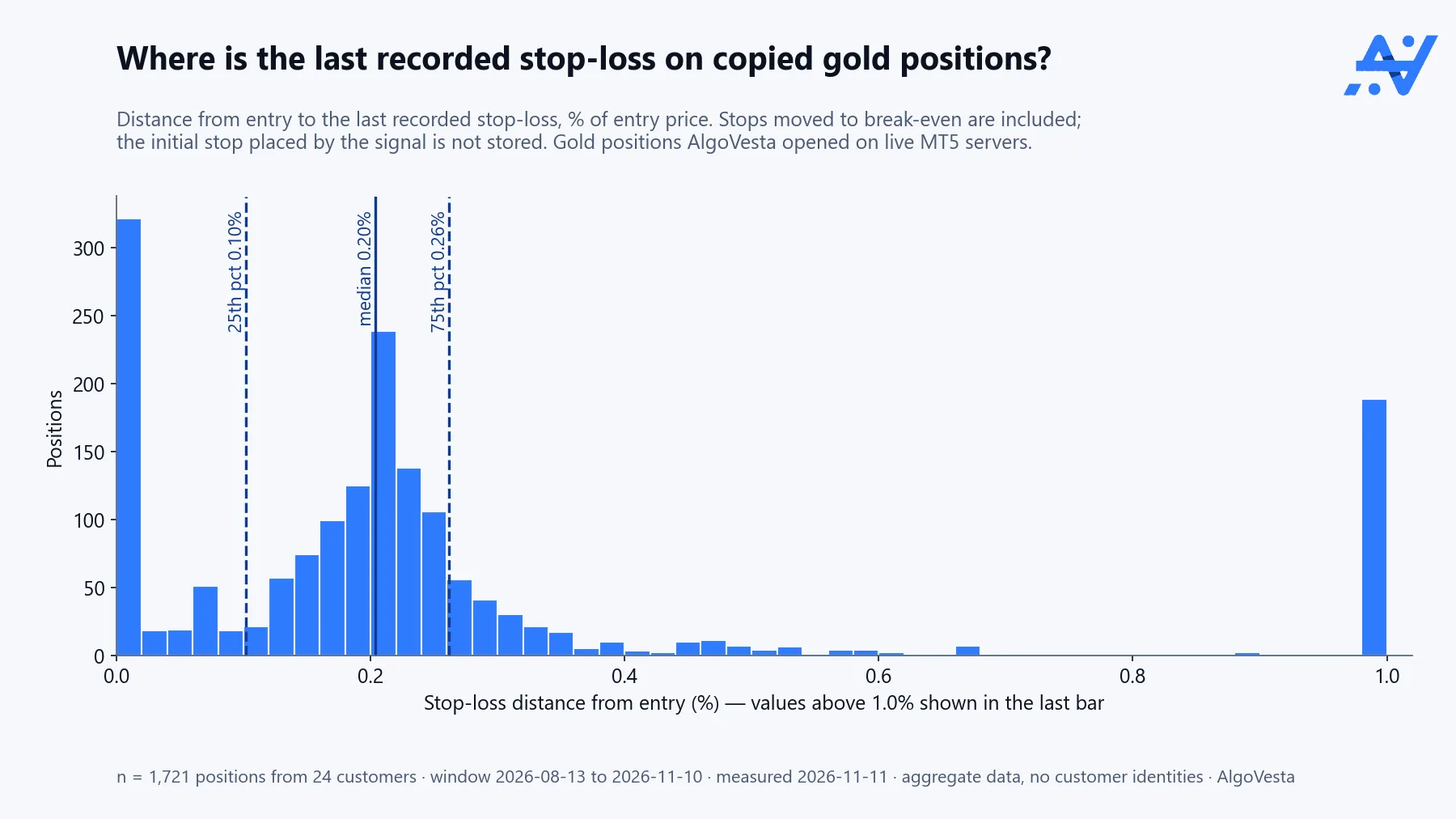
How to read the stop-loss figure. Our records keep the stop where it ended up, not where the signal first placed it, so a stop moved to break-even counts at its final distance. That is why we publish the last recorded distance and no initial stop distance, and why we publish no reward-to-risk ratio built on it.
How to read the timing figure. Opening times follow when signal channels publish, not when the market is deepest; a trader who copies a channel inherits its schedule.
Counting rules. Instruments are classified by symbol prefix; gold covers XAUUSD and its broker variants. A signal with several take-profit targets opens several MT5 positions, and each one is counted. Groups other than gold had fewer than five customers each and are not shown.
What are the limits of this data?
- Our customers are not the whole market, and the sample is small.
- Positions show what customers chose to copy, not what a signal channel recommended in general.
- Close reasons are not profits, and we did not measure profit or loss in any study.
- Two studies with different windows are not combined into one figure.
Which studies have we published?
- What happens to a trading signal? 90 days of AlgoVesta data (3 August to 31 October 2026): signal outcomes, order times, stop-loss coverage and close reasons.
- Copied MT5 positions, August to November 2026 (this page): instrument mix, last recorded stop-loss distance and opening hours.
- Telegram to MT5 latency: 1,523 positions measured (18 August to 15 November 2026): time from a Telegram message reaching AlgoVesta to an open MT5 position.
Each study is repeated every quarter with the same tables so the series can be compared. The next update is planned for the first quarter of 2027.
How can you cite or request the data?
Please cite as: "AlgoVesta operating data, <study title>, measured <date>." Journalists and researchers can request the full aggregate tables at [email protected].
Trading involves substantial risk of loss. Software, not advice.
Related: Results · How it works · About · Security