Short answer: AlgoVesta connects your TradingView alerts and Telegram signals directly to your Binance account, automatically opening, managing, and closing spot and futures trades — with built-in risk controls on every order. You bring the signal and your Binance API keys; AlgoVesta handles execution.
Binance is the world's largest cryptocurrency exchange by trading volume, with deep liquidity across spot and futures markets. But that liquidity is only an edge if your orders land the moment a signal fires — not four minutes later, after you've copy-pasted a price into the wrong field.
Why automate Binance specifically
Common reasons traders automate Binance:
- Deepest liquidity — Binance's order books are large enough that automated entries rarely move the market against you.
- 24/7 markets — crypto never sleeps, but you do; automation trades while you don't.
- Consistency — every qualifying signal is executed the same way, with the same risk rules.
What you need
Three things, and nothing more:
- A signal source — a TradingView strategy that fires alerts, or a Telegram channel you subscribe to.
- A Binance account with API keys — read and trade permissions only. Withdrawal permission is never required.
- AlgoVesta — the routing engine that connects the two and enforces your risk rules.
How to connect TradingView to Binance
The flow is straightforward:
- Create your Binance API key — in Binance, go to API management and generate a key with read and trade permissions. Do not enable withdrawal.
- Add the key to AlgoVesta — keys are stored encrypted; AlgoVesta uses them only to place and manage orders.
- Connect your TradingView alert — point your strategy's webhook alert at AlgoVesta. When the alert fires, AlgoVesta receives it instantly.
- Define your rules — set position size, leverage, stop-loss, take-profit, and which symbols to trade.
- Go live — every qualifying TradingView alert is now executed on Binance automatically.
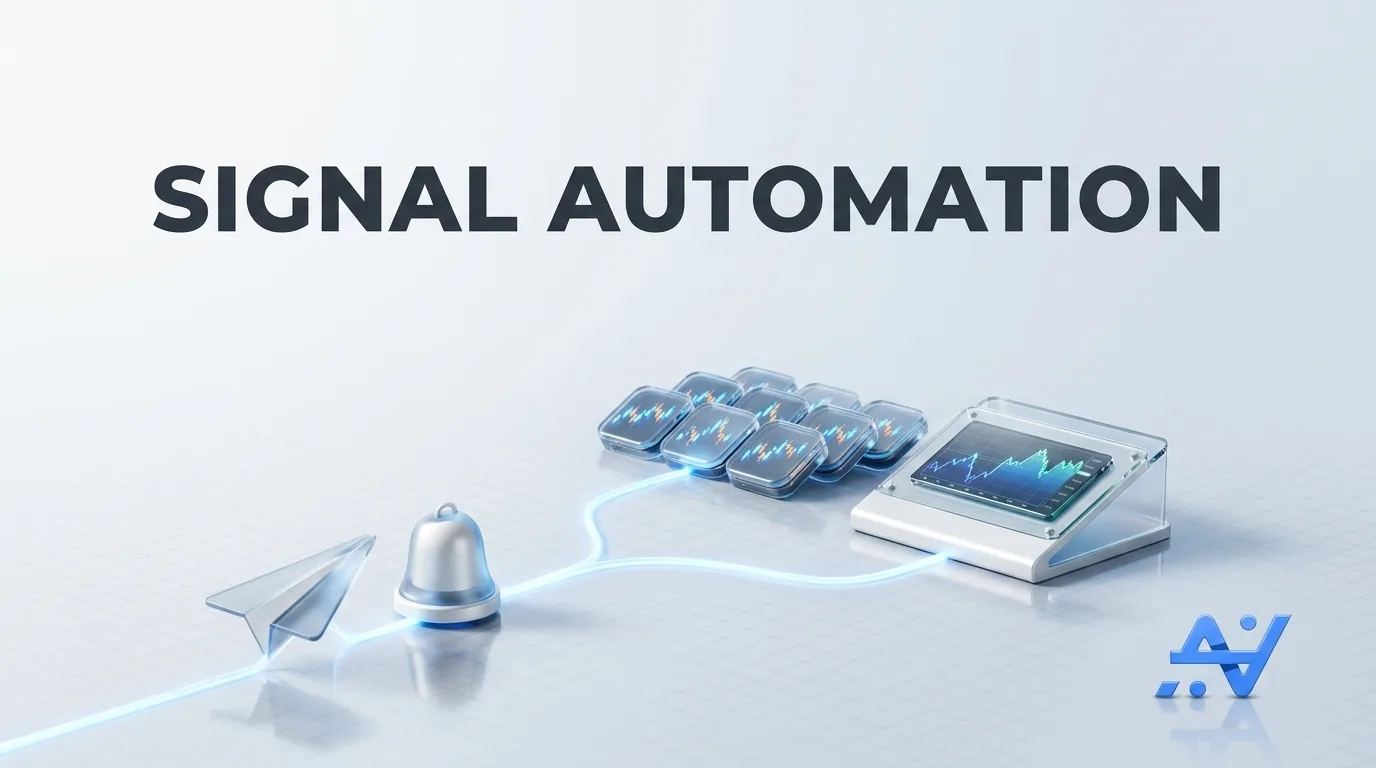
How to connect Telegram signals to Binance
If your edge comes from a Telegram channel rather than your own strategy, the setup is similar:
- Connect the Telegram channel you subscribe to as a signal source.
- AlgoVesta parses incoming signals and maps them to Binance orders.
- Your risk rules apply to every signal, regardless of what the channel says.
You stay in control of which channels you trust and how much risk each signal can take.
Risk controls on every Binance order
Routing fast is the easy part. Protecting capital is what matters. Every signal passes through AlgoVesta's integrated risk layer before it becomes a live Binance order:
- Daily stop — halts trading after a defined daily loss.
- Drawdown brake — reduces exposure as equity falls.
- Correlation and global-max limits — prevents over-concentration.
- Position sizing — enforces consistent risk per trade.
- Kill-switch — instant full stop when limits are breached.

These run regardless of the incoming signal. A bad signal cannot blow up an account that has hard limits enforced upstream.
Binance is one of 16 supported exchanges
AlgoVesta is not Binance-only. The same engine routes signals to 16 crypto exchanges — including Bybit, OKX, Coinbase, KuCoin, Gate.io, Bitget, and more — as well as MetaTrader 5 for forex. If you trade on more than one venue, AlgoVesta runs them all from a single dashboard with one risk framework.
Learn more in our overview of signal automation across 16 exchanges and MT5.
Get started
Generate your Binance API key (trade permission), connect your TradingView or Telegram source to AlgoVesta, set your rules, and let automation handle execution. See pricing and the free trial to start.
Disclaimer. AlgoVesta is signal-routing automation infrastructure. It does not provide investment advice, signals, or trading recommendations. You are responsible for the signal sources you connect and the rules you define. Crypto trading carries substantial risk of loss.
The authoritative version of this article is the English original; translations are provided for convenience.
Ready to automate your trading workflow?
Connect your exchange with secure, trade-only API keys.
Start Free — 7 DaysRelated comparisons: Cornix · TSCopier · TelegramFXCopier · Copygram · TelegramSignalCopier