Short answer: AlgoVesta executes a trade when a signal arrives from any of three sources — a Telegram channel, a TradingView alert, or your AI assistant through MCP (Claude, ChatGPT, Cursor) — and routes it to 16 crypto exchanges or MetaTrader 5 under your risk rules. All three doors lead to the same execution engine, risk framework, and trade-only security. You can use whichever source fits the trade in front of you.
Most automation tools are built around one input: Telegram, TradingView, or, more recently, an AI agent. Active traders rarely work that way. You may use a Telegram channel for one strategy, a TradingView alert for a backtested system, and an AI-assisted trade when you are away from your desk. The signal source changes; execution and protection should not.
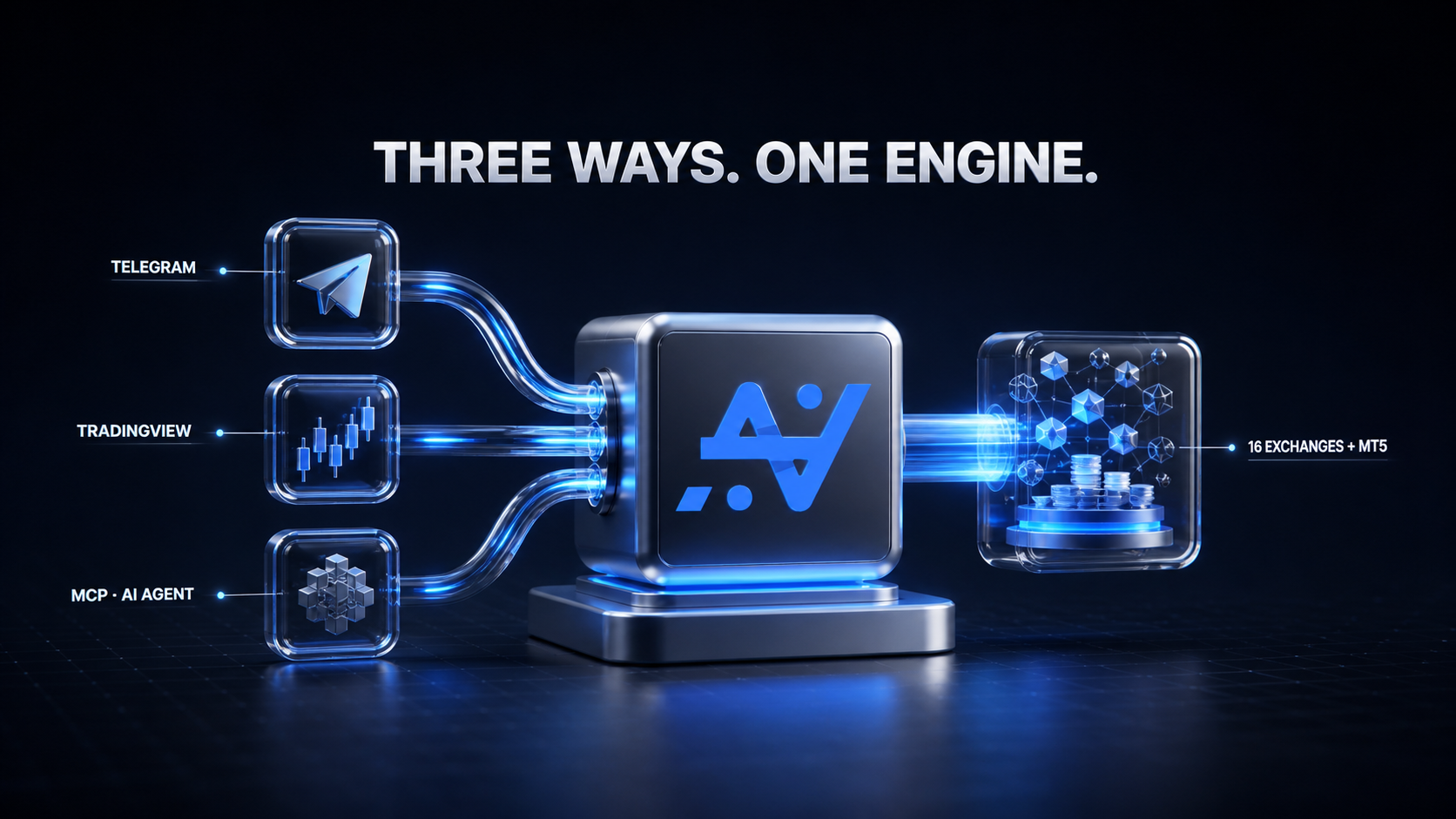
Why one execution engine with three doors matters
A Telegram message, a TradingView webhook, and a natural-language request from an AI assistant are different formats. The execution layer must convert each one into the same structured order — symbol, direction, size, stop-loss, and take-profit — and apply identical rules before it reaches a venue.
That common engine keeps position sizing, daily loss limits, drawdown protection, and account-level exposure consistent. A Telegram-triggered trade and an AI-agent-triggered trade do not run through separate safety systems.
Door one: Telegram
If your edge comes from a signal channel you trust, AlgoVesta connects directly to it. Public and private groups are supported.
- AI reads text in different formats and languages, extracting symbol, direction, stop-loss, and take-profit; image signals can be read through OCR.
- Channels are monitored 24/7, with multiple channels running in parallel and separate rules for each source.
- Orders open within seconds with stop-loss and take-profit attached according to your configuration.
You choose the source. AlgoVesta never supplies signals of its own. See the full walkthrough for Telegram signals to crypto and MT5.
Door two: TradingView
If your edge is a strategy you built and tested, a TradingView webhook provides a direct path from alert to order.
- Paste one webhook URL into the alert as a one-time setup; no code or manual JSON writing is required.
- Orders execute in about 1.2 seconds on MT5 and about 4.1 seconds on a crypto exchange on average.
- An optional AI filter can screen manipulated or duplicate signals, while each result is logged with its score and reasoning.
Your Pine Script strategy fires the alert; AlgoVesta handles routing and execution. Read the technical guide to automating TradingView alerts to crypto and MT5.
Door three: your AI agent through MCP
AlgoVesta runs an MCP server for 16 exchanges + MT5. It connects Claude, ChatGPT, Cursor, or another MCP-capable client to the same execution layer used by Telegram and TradingView.
- Ask your assistant to inspect your portfolio, simulate an order, or place one in plain language.
- Build a personal agent that follows your instructions and operates continuously within the rules you set.
- A server-side policy wall applies after the AI decides and before a venue is touched, so prompts cannot bypass account limits.
This turns an AI assistant from an opinion interface into a controlled execution client. See how to trade by talking to your AI.
Same engine, same rules, every time
Whichever door a signal enters through, it passes through the same pipeline before becoming a live order:
- One risk framework: position sizing, stop-loss enforcement, daily loss limits, drawdown protection, correlation and global-max limits, plus a kill-switch.
- One destination layer: 16 crypto exchanges for spot and futures, plus MT5, from one dashboard.
- One security model: trade-only access encrypted with AES-256. Withdrawal permission is never granted, so funds cannot be moved out.
- Paper-first testing: a $5,000 virtual balance lets you test every source before connecting real capital.
AlgoVesta is non-custodial signal-routing infrastructure. Your funds remain in your own exchange or broker account, and you control the signal sources and risk settings.
Which door fits which trader?
- Telegram: you follow a signal provider and want calls executed without monitoring your phone.
- TradingView: you have built and tested a strategy and want it to execute when its conditions are met.
- MCP / AI agent: you want conversational portfolio access, order simulation, or a personal agent operating within your rules.
You do not have to choose only one. Telegram, TradingView, and MCP can run side by side without changing the account-level execution or risk framework.
Try all three before you commit
Paper trading starts with a $5,000 virtual balance using real market data. Connect a Telegram channel, add a TradingView webhook, or link your AI assistant and observe how the same engine processes each source. Paid plans start at $32.50/month when billed yearly ($390/year), with a 7-day free trial and no card required.
The bottom line
Trading automation should not force a choice between Telegram, TradingView, and AI. AlgoVesta runs all three through one execution engine, one risk framework, and one trade-only security model across 16 crypto exchanges and MetaTrader 5. Use the door that fits the trade; the rules remain the same.
Explore each path in detail: Telegram to crypto and MT5, TradingView automation, or trading with your AI agent.
Learn more: the live demo.
Disclaimer. AlgoVesta is signal-routing automation infrastructure (Bring Your Own Signal). It does not generate signals and does not provide investment advice or trading recommendations. It runs execution infrastructure on your behalf using trade-only credentials and does not hold, receive, or move client funds. You choose the signal sources you connect and the rules you define, and you are responsible for both. Crypto and forex trading carry substantial risk of loss; leveraged positions may be fully liquidated. Past performance does not guarantee future results.
The authoritative version of this article is the English original; translations are provided for convenience.
Related comparisons: Cornix · TSCopier · TelegramFXCopier · Copygram · TelegramSignalCopier